
• Skip to main content
  • Skip to navigation
  • Accessibility
  • Contact Us
Government of Western Australia Crest
Government of Western Australia
Government of Western Australia Crest

Additional Menu

  • Accessibility
  • Contact us
Go to WA Government search
  • FHRI Fund
    • FHRI Fund Act
    • FHRI Fund Advisory Council
      • Past members
      • Meeting communiques
    • Strategy
    • Priorities
    • Programs and Initiatives
    • FHRI Fund Expert Committees
    • FHRI Fund governance model
    • Publications
      • Annual Reports
  • Funding
    • Current funding opportunities
      • FHRI Fund Distinguished Fellows 2025-26
      • Major Research and Innovation Application Support Program
      • Research Infrastructure Support 2026
      • Spotlight 2025-26 Rheumatic Heart Disease
      • WA Cohort Studies - Operational Support Program 2026
    • Funding outcomes
    • DoH Grant Management System user guides
    • FHRI Fund Scheme Annual Investment Plan
    • Past Open Days
    • Past funding opportunities
      • RICCB Program
      • RIS2024
      • Implementation Fellowships 2021
      • Translation Fellowships 2021
      • Biobank Support 2021
      • RTP 2021
      • MHRIF 2021
      • CRT Program 2022-23
      • Clinician Researcher Training Program 2024-25
      • Co-Funding Partnerships Program
      • Collaborative Centres
      • DISCOV3R
      • FHRI Fund Consumer and Community Involvement Support
      • FHRI Fund Distinguished Fellows 2024-25
      • Distinguished Fellows Program
      • FHRI Fund Enabling Scheme 2024-25
      • Innovation Challenge 2021
      • Generative AI Challenge
      • Innovation Challenge - SHP
      • Innovation Fellowships 2024
      • Innovation Fellowships 2024-25
      • Innovation Seed Fund 2022-23
      • Innovation Seed Fund 2023-24
      • Innovation Seed Fund 2025-26
      • Innovative Solutions - DH
      • Innovative Solutions - Precision Health 2024
      • Major Research and Innovation Application Support Round 3
      • MRIAS
      • Major Research & Innovation Application Support Round 6
      • MRAS
      • NCRIS Partner Program 2024-25
      • Research Excellence Awards 2022
      • Research Infrastructure Support 2025
      • Targeted Call - HSS
      • WACS-OSP
      • WACS-RSP
      • WA Cohort Studies – Operational Support Program 2024-25
      • WA Near Miss Awards Emerging Leaders 2025-26
      • WANMA: Emerging Leaders
      • WA Near-Miss Awards (WANMA) Ideas Grants Program
      • WA Near-miss Awards Emerging Leaders 2024-25
      • WA Near-miss Awards Ideas Grants 2024-25
  • Research
    • Health and medical research
    • Research ethics and governance
  • Innovation
  • Consumers
    • CCI Coordinator
    • FHRI Fund Consumer and Community Involvement
  • News and Events
  • Get involved
    • Past engagements
  • Subscribe
  1. Home
  2. News and Events
  3. 2026
  4. 02
  5. 27
  6. World Rare Disease Day: Fast tracking diagnosis for children with rare disease

World Rare Disease Day: Fast tracking diagnosis for children with rare disease
World Rare Disease Day: Fast tracking diagnosis for children with rare disease

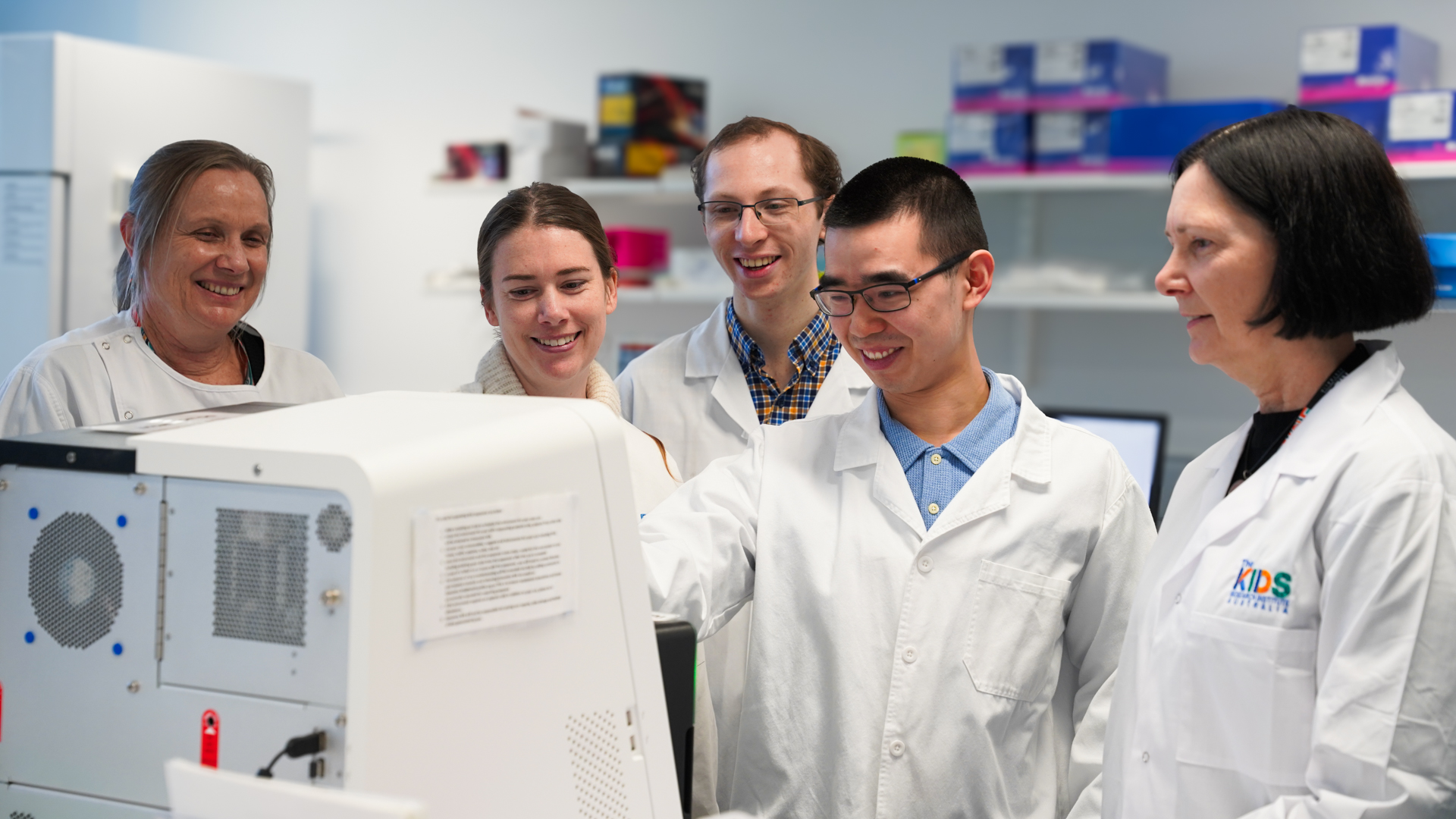
Dr Vanessa Fear and team at The Kids Research Institute Australia
27/02/2026

Future Health Research and Innovation (FHRI)–funded research at The Kids Research Institute Australia is working to dramatically shorten the time it takes for children with rare disease to receive a diagnosis.

Rare diseases collectively affect about 8 per cent of the population and are defined as conditions affecting fewer than 1 in 2,000 people. In Western Australia alone, an estimated 63,000 children live with a rare disease — a number large enough to fill Optus Stadium.

Despite their individual rarity, rare diseases have a profound impact. They are the leading cause of death in children, accounting for 6 in 10 childhood deaths. For families, the journey is often long, complex and deeply challenging.

A long road to answers

For many children and families living with rare disease, reaching a diagnosis involves a prolonged and arduous journey. On average, individuals experience a diagnostic odyssey of more than 6 years, and for some, a diagnosis is never achieved at all.

This uncertainty affects every aspect of life. Families seek answers not only to understand the cause of disease, but to support care decisions, life planning and future generations.

The challenge of genetic uncertainty

Genetic sequencing has transformed rare disease diagnosis, but significant gaps remain. In today’s clinics, genetic testing identifies a disease‑causing (pathogenic) variant in around half of patients.

For the remaining patients, testing often reveals a variant of uncertain significance (VUS) — a genetic change that may or may not be responsible for the disease. Determining whether these variants are truly disease‑causing is complex and time‑consuming, leaving families waiting months or years for answers.

A new approach to diagnosis

At The Kids Research Institute Australia, researchers are developing a new laboratory test designed to reduce the time it takes to diagnose rare disease — delivering answers in months rather than years.

The test brings together the latest advances in:

  • stem cell disease models
  • precision gene editing
  • advanced genomic technologies

By rapidly assessing whether a genetic variant is likely to be causing disease, the approach aims to fast‑track genetic variant interpretation and deliver clearer, more informative answers for families and clinicians.

From research to real‑world impact

The project is a collaborative effort led by:

  • Dr Vanessa Fear, Head of Translational Genetics, The Kids Research Institute Australia
  • Associate Professor Timo Lassmann, Theme Leader, Precision Health, The Kids Research Institute Australia
  • Clinical Professor Gareth Baynam, Medical Director, Rare Care Centre

The work is embedded within the WA Rare Care Comprehensive Centre (RCCC), a world‑leading initiative that brings together families, researchers, clinicians, data scientists and policymakers to drive directly translational rare disease research.

Central to the Centre’s success is the close connection between families living with rare disease and the research community — ensuring scientific innovation is grounded in real‑world need and focused on improving outcomes for children and families.

Previous Next
Last Updated: 27/02/2026
  • Twitter
  • YouTube

Footer menu

  • wa.gov.au
  • Copyright
  • Disclaimer
  • Privacy
  • Sitemap
  • Contact Us

Brought to you by the Department of Health, Western Australia

© Government of Western Australia 2018 to