

Spotlight 2026-27 Healthy Beginnings, Lifelong Wellbeing
The Spotlight Program brings WA’s health and medical research and innovation sector together around one bold, Western Australian health challenge (focus area) each year, to drive lasting solutions.
Each round centres on a focus area identified as a strategic priority for WA. The Spotlight focus area for 2026-27 is Healthy Beginnings, Lifelong Wellbeing.
Through a competitive process, up to $25 million over 5 years, will be awarded to a single WA-based team to drive ambitious, coordinated research and innovation across conception, pregnancy, birth, infancy and early childhood up to the age of 3 years (36-months) old, creating lasting change that gives every child the best possible start and sets the foundation for lifelong wellbeing.
The Spotlight 2026-27 Healthy Beginnings, Lifelong Wellbeing Program is open to all WA entities that meet eligibility criteria outlined in the Program Guidelines and Conditions.
Grant funding will be released in 2 parts.
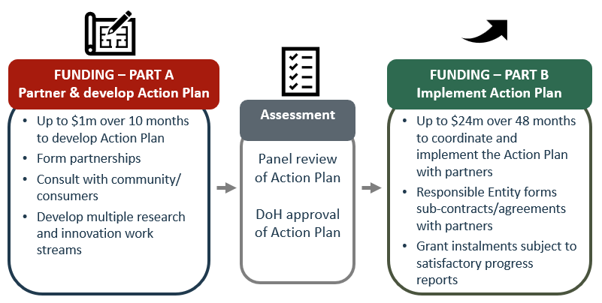
Part A provides up to $1 million over a period of up to 10 months, to enable the Spotlight Coordinating Team to form partnerships and consult with consumers, community and stakeholders to develop a sector wide Spotlight Action Plan consisting of multiple research and innovation work streams.
Part B provides up to $24 million over a period of up to 48 months, to coordinate and implement with Spotlight partners, the defined activities set out in the approved Action Plan. Part B funding will be released in instalments as specified in the Grant Funding Agreement. The Responsible Entity is responsible for forming appropriate agreements with the Spotlight partner organisations for their research and innovation activities.
Program Status: Open for Applications
Applications Close: 1.00pm (AWST), Tuesday 23 March 2027
The Guidelines and Conditions can be accessed below.
The Application Form can be accessed and submitted via the Department of Health Grant Management System.
To view the application questions, after starting an application in the Grant Management System select ‘preview’ in the top right corner, which will download the application form questions (and your responses) as a Word or PDF document. For further instructions, please refer to page 9 of the User Guide ‘Downloading the application form’.
Queries related to the Guidelines and Conditions can be directed via email to DOH.OMRI@health.wa.gov.au with the subject line beginning with ‘Query – Spotlight 2026-27 – HBLW’.
Queries regarding the application process can be directed via email to DOH.GMS@health.wa.gov.au with the subject line beginning with ‘GMS Application Assistance – Spotlight 2026-27 – HBLW’.
Information on how to co-invest with the Spotlight program can be found in the FHRI Fund Spotlight Co-investment Guidelines.
Information on other FHRI Fund programs can be accessed by subscribing to updates or checking the FHRI Fund current opportunities.
Frequently Asked Questions
Please note: applicants should refer to the official Guidelines and Conditions for full details and compliance requirements.
Question: How do I apply?
Answer:
The Spotlight Application Form is available via DoH Grants portal, the Department of Health’s online Grant Management System. To access the online form, follow the link provided on the FHRI Fund website. Please refer to the Application submission user guide provided for instructions on how to create an account and submit an application.
Question: How does the application process work for Spotlight?
Answer:
The application process for Spotlight seeks to identify a single Spotlight Coordinating Team to be awarded the Spotlight grant.
Applicants must propose a sufficiently capable and experienced Spotlight Coordinating Team, and outline how they plan to consult and partner with key stakeholders during Part A (Partner and develop Spotlight Action Plan), should they be awarded the grant.
Applications should ONLY outline activities that would take place during Part A. A full spending and engagement plan for the $25 million grant is NOT required at this stage. Detailed partner identification and allocation will occur during the first 10 months after award (Part A: Partner and develop Spotlight Action Plan).
Question: What needs to be included in the Part A application?
Answer:
Applications should demonstrate the Spotlight Coordinating Team’s:
- suitability to lead the Activity
- demonstrated understanding of opportunities for research and innovation
- plan for consultation and collaboration during Part A
- plan for developing a comprehensive, sector-driven Action Plan to address all aspects of the Spotlight focus area
- plan for forming and managing partners during Part A
- plan for streams of research and innovation
- budget request for Part A
- consideration of cash and in-kind contributions.
Applications should provide sufficient detail to demonstrate capability and readiness to develop a comprehensive, sector-driven Action Plan, coordinate multiple partners and workstreams, and deliver strong governance, cultural engagement, and consumer involvement.
Eligible applications will be referred for full assessment and scoring by a review panel.
Figure 1: Application process for Spotlight

Question: Will another proposal be submitted after 10 months for Part B?
Answer:Once selected, the awarded applicant will receive up to $1 million over a period of 10 months to consult widely, form partnerships, and prepare the Action Plan for Part B.
The Action Plan developed during Part A will be reviewed by the Grant Review Panel and approved by the Department of Health (DoH) before implementation funding (up to $24 million) is released.
Templates and guidance for developing the Action Plan will be provided to the successful recipient at the start of Part A.
Figure 2: Post-award – Spotlight Coordinating Team to plan and implement Spotlight Action Plan
Question: Is there any guidance on the expected size and composition of the “Spotlight Coordinating Team”?
Answer:
The Guidelines and Conditions recommend approximately 10 people for the Spotlight Coordinating Team. This is a guide only and the final number at the discretion of each applicant.
Spotlight Coordinating Team members should include those who will be involved in implementing Part A (Partner and develop the Spotlight Action Plan) activities. It is not necessary to include partners who may be involved in Part B (Implement the Spotlight Action Plan) here, as all partners will be identified during the development of the Action Plan following award of Part A.
The number of members should be determined by the mix of skills, relevance, experience, track record of members ensuring suitability to collectively lead and manage large-scale initiatives.
Applicants should note that the Spotlight Coordinating Team will be assessed under Leadership and Capability (weighted at 25%) which considers skills, experience and relevance to the Program focus area, as well as track record in leading and managing large-scale, collaborative health initiatives.
Question: Should project managers or operational staff be included as part of the Spotlight Coordinating Team?
Answer:
Yes, they can be. Project managers and operational staff can be included in the Spotlight Coordinating Team if they have a clear role in coordinating Spotlight activities. This may include responsibilities such as:
- managing timelines, deliverables, and reporting
- supporting governance and compliance processes
- facilitating communication and collaboration across multiple partners
- ensuring consumer and community engagement activities are implemented effectively.
The Spotlight Coordinating Team is not expected to be composed solely of researchers or innovators. Including experienced operational staff may strengthen applications, particularly in demonstrating robust program management capability, which is assessed under Program Management and Feasibility (weighted at 20%).
Question: What level of commitment (e.g. FTE) is expected for the Activity Lead?
Answer:
The Guidelines and Conditions do not prescribe a specific FTE requirement for the Activity Lead. FTE commitment should be adequate to coordinate the activities for Part A.
Applicants should note that the Activity Lead and Responsible Entity carry the majority of contractual responsibilities, including:
- developing and submitting the Action Plan
- coordinating multiple activities and partnerships
- ensuring governance, compliance, and reporting obligations are met.
Question: Does the governance structure and members need to be fully confirmed prior to submission? If not, can roles be outlined without naming individuals?
Answer:
Governance is assessed under ‘Program Management and Feasibility’ (weighted at 20%). Part A applications should outline proposed governance structures; however, final governance arrangements are not expected to be established until the end of Part A, once the Action Plan is finalised.
Question: How will conflicts of interest be managed for researchers or clinicians involved in the application who are employed by WA Health?
Answer:
Conflicts of interest (COI) should be treated in accordance with the WA Health System Managing Conflicts of Interest Policy.
WA Health employees applying to the Program or who are partners in the Action Plan are required to fill in a COI declaration and, based on assessment of that declaration by their managers, put appropriate arrangements in place. These arrangements will be determined on a case-by-case basis by the responsible area.
Question: Do consumers need to be fully confirmed prior to submission? If not, can roles be outlined without naming individuals?
Answer:
Engaging consumers and community members is assessed under ‘Consultation and Collaboration’ (weighted at 20%). The Application requires provision of plans for meaningful engagement and co-design with families, caregivers and people with lived experience, particularly those from priority populations and should be adequate to convince the review panel of genuine involvement.
The Application Form requires you to describe your plan to partner and consult with consumers and community.
Question: How will partner organisations play a role in the Spotlight Program?
Answer:
Partnerships are a core element of the Spotlight Program. There is no limit on the number of partnerships that can be formed. It is expected that partnerships will be extensive and cross-sector, involving research, innovation, healthcare, community, and government stakeholders.
At the time of the Spotlight application, the Spotlight Coordinating Team will be expected to have clear plan to build new partnerships with key stakeholders should they be selected to develop the Action Plan. Development of partnerships is expected once the Part A grant has been awarded and the process of developing the Action plan is commenced. We therefore do not expect an exhaustive and complete list of partners at this stage as the partnerships may change as the Spotlight lead conducts their planning over the first 10 months.
It is expected partner organisations will deliver key streams of research and innovation activities contributing to the overall solution. The Responsible Entity will be responsible for forming sub-contracts or other appropriate agreements with partner organisations for their research and innovation activities.
Question: Which organisations should applicants engage and partner with to ensure a collaborative and impactful Spotlight initiative?
Answer:
Applicants should consult and partner with organisations that bring diverse expertise and community representation to the initiative, however an exhaustive list of partners is not required at the time of application. Instead, it is expected that partnerships will be formed over the course of developing the Spotlight Action Plan.
Part B (Implement the Spotlight Action Plan) will require extensive partnerships with researchers, innovators, clinicians, Aboriginal Controlled Organisations and government organisations including those outside of the health area to ensure a community-led, co-designed and system-wide approach.
Question: What type of organisations will be ideal/desired to coordinate activities?
Answer:
The Office of Medical Research and Innovation (OMRI) welcomes applications from all organisations that meet eligibility criteria outlined in the Program Guidelines and Conditions. Ideal coordinators will be those with the capacity to manage complex, multi-stakeholder initiatives and deliver program objectives effectively.
Question: Do partners need to have a physical presence in WA?
Answer:
The Guidelines and Conditions do not omit partners or subcontracting outside of WA; however, the Guidelines and Conditions states: ‘The intention is that funding will be spent within WA unless goods and services expenditure items are not available in WA and/or it is beneficial to WA if goods or services are procured from outside WA. Expenditure outside WA should be justifiable.’
Question: If the Responsible Entity subcontracts activities, do subcontracted organisations also need a physical presence in WA?
Answer:
As above – an organisation’s physical presence in WA is not mandatory, but expenditure outside WA must be justified.
Question: Will salary oncosts be limited and/or capped?
Answer:
Salary on-costs can only include superannuation, payroll tax and workers compensation, up to a maximum of 30%, noting that salaries paid by a WA public health system entity can only include superannuation as a salary on-cost (this includes WA public health system invoices for salaries paid by the Responsible Entity).
Question: Will infrastructure costs be capped?
Answer:Infrastructure costs will be capped at 10%. Overhead charges such as indirect/infrastructure costs may be requested up to a maximum of 10% of the total Activity (direct) costs and must be justified/described.
WA public health system Responsible Entities cannot claim overhead charges or charge overheads on invoices paid by the Responsible Entity for grant expenditure in accordance with the WA Health Financial Management Manual (FMM) s522. The FMM does not allow WA Health to include overheads when funding is provided by an exempt organisation such as OMRI.
Question: Can honoraria for community members, Elders, Aboriginal community members or lived-experience representatives be included in the budget and are there recommended rates?
Answer:
Yes. Honoraria for community members, Elders, and lived-experience representatives can and should be included in the budget as part of consumer and community involvement activities. Please see the section of the Guidelines and Conditions, which outlines expectations for consumer involvement.
Applicants are advised to use rates set by their internal policies or refer to the Health Consumers Council WA Consumer Representative Policy. For WA public health system Responsible Entities, refer to the Department of Health’s Consumer, Carer and Community Paid Participation in Engagement Activities Policy.
Question: Should funding requests for both Part A (Partner and develop Spotlight Action Plan) and Part B (Implement Spotlight Action Plan) be included in the initial application?
Answer:
The budget in the Application Form is for Part A only (up to $1 million over 10 months). FTE commitment in the application should be adequate to coordinate Part A activities. Once the grant is awarded, the funding recipient will be expected to outline the plan for allocation of funds (up to $24 million) in the Spotlight Action Plan.
Question: Guidelines state, ‘Non-salary costs related to travel for consultation and co-design are expected but must be justified’. Will approval need to be ad hoc, or can we allocate funding in the budget request and justify upfront?
Answer:
Travel approval is determined at the Application Form stage for Part A (Partner and develop the Spotlight Action Plan) and in the Action Plan for Part B (Implement the Spotlight Action Plan), not on an ad hoc basis. All anticipated travel costs for Part A should be included in the initial budget request and strongly justified in the Application Form.
Once the grant is awarded, funding recipients will be expected to outline the plan for allocation of funds during Part B of the Program, including travel and related justifications, in their comprehensive Action Plan.
Question: Who will the Spotlight Coordinating Team be meeting with from FHRI Fund/WA Health during the 10-month consultation period, and how often are these check-ins expected?
Answer:
It is anticipated regular meetings will be put in place with members from OMRI. The frequency can be proposed by the applicant in the response to ‘Program Management and Feasibility’.